


During my time leading policy and strategy at the Pentagon’s Joint Artificial Intelligence Center, I probably heard references to Arnold Schwarzenegger and the Terminator movies every single week, if not every day. Science-fiction depictions of AI are so dominant as the default mental model that it’s difficult to have a conversation without referencing them.
So, it’s a bit disappointing that I practically never hear anyone mention Kurt Vonnegut’s 1952 debut novel Player Piano when we talk about AI taking our jobs. Player Piano is not a masterpiece of the same caliber as Vonnegut’s two best-known works, Slaughterhouse-Five and Cat’s Cradle, but the novel is a fun, funny, and occasionally insightful book about a dystopian future in which widespread mechanization has destroyed effectively all demand for working-class labor. Only the engineers and managers who design and repair the machines can enjoy steady employment.
The book really has quite a lot to offer:
Technology-driven unemployment and the resulting loss of human dignity;
Genius engineers and other economic elites blaming the victims of automation only to later see themselves automated; and
Make-work government jobs programs and guaranteed material security (sort of like universal basic income) as necessary policy outcomes.
Beyond its virtues as a novel, Player Piano is also a helpful reminder that concerns about automation and its effect on unemployment have been with us almost uninterrupted since the violent crushing of the machine-breaking Luddite rebellion in the early 1800s. Even 20th century American politicians like John F. Kennedy—whose Apollo moon program led to phenomenal growth in science and engineering—acknowledged that accelerating automation was a policy problem.
During his 1960 campaign for president, Kennedy gave a speech at a major labor union convention that, with some light tweaking, would work nearly perfectly as a speech for a politician today. Here’s how the speech opens:
“Today we stand on the threshold of a new industrial revolution – the revolution of automation. This is a revolution bright with the hope of a new prosperity for labor and a new abundance for America – but it is also a revolution which carries the dark menace of industrial dislocation, increasing unemployment, and deepening poverty.
Already entire automobile engines are being manufactured, untouched by human hands. Modern lathes and drills are turning out parts machined to the closest tolerances, guided only by electrical impulses which make the settings and automatically correct all errors. Electronic equipment is sorting material as it enters a warehouse and carrying it – without human guidance – to its proper place of storage. And in the future, as the complexity, the versatility, and the precision of modern technology continues its inevitable advance, thousands of processes and functions now performed by men will be done, more cheaply and more efficiently, by machine.”
The full speech is a fascinating, eloquent artifact. And just as Kennedy’s framing of the problems rings familiar, so too do his prescriptions: government aid to encourage companies to adopt machines that augment workers rather than replace them, combined with welfare benefits and retraining for displaced workers.
Between Vonnegut and Kennedy, one could be forgiven for thinking that there’s nothing new under the sun when it comes to the debate on automation and labor. AI is just the mechanical loom, steam engine, tractor, and electronic equipment debates all over again.
At least in terms of the public, mass-media debate on these issues, I think this is correct. But that’s only because the public debate on automation and labor remains stubbornly stuck at the Econ 101 level. What I’m going to cover next are the four case studies and six economic intuitions that most helped me to get past the 101 level. Each of the case studies—agriculture, horses, music, and chess—offers illuminating and instructive lessons for the changing shape of the labor market in the AI era.
What actually happens will, of course, depend on the rate of technological progress and adoption on a sector-by-sector basis. What these cases give you is a way to see what would have to be true for each AI scenario to be plausible. I have deliberately left out policy recommendations. That will be the subject of a future essay.
I’ll begin with agriculture, unpacked in two parts.
Agriculture Part 1: Sectoral labor demand vs. overall labor demand
Why automating jobs doesn’t have to increase unemployment
In 1900, 41% of the American labor force (11.9 million people) was employed in agriculture. Seventy years later, in 1970, only 4% of the labor force (3.1 million people) was employed in agriculture. That is a 10-fold reduction in labor share at a time when the number of mouths to feed (the overall American population) nearly tripled from about 75 million to about 205 million. Despite using far fewer human workers, the agricultural sector produced far more food and other outputs. Over that same period, the number of operational tractors on American farms increased from basically zero to 4.7 million.
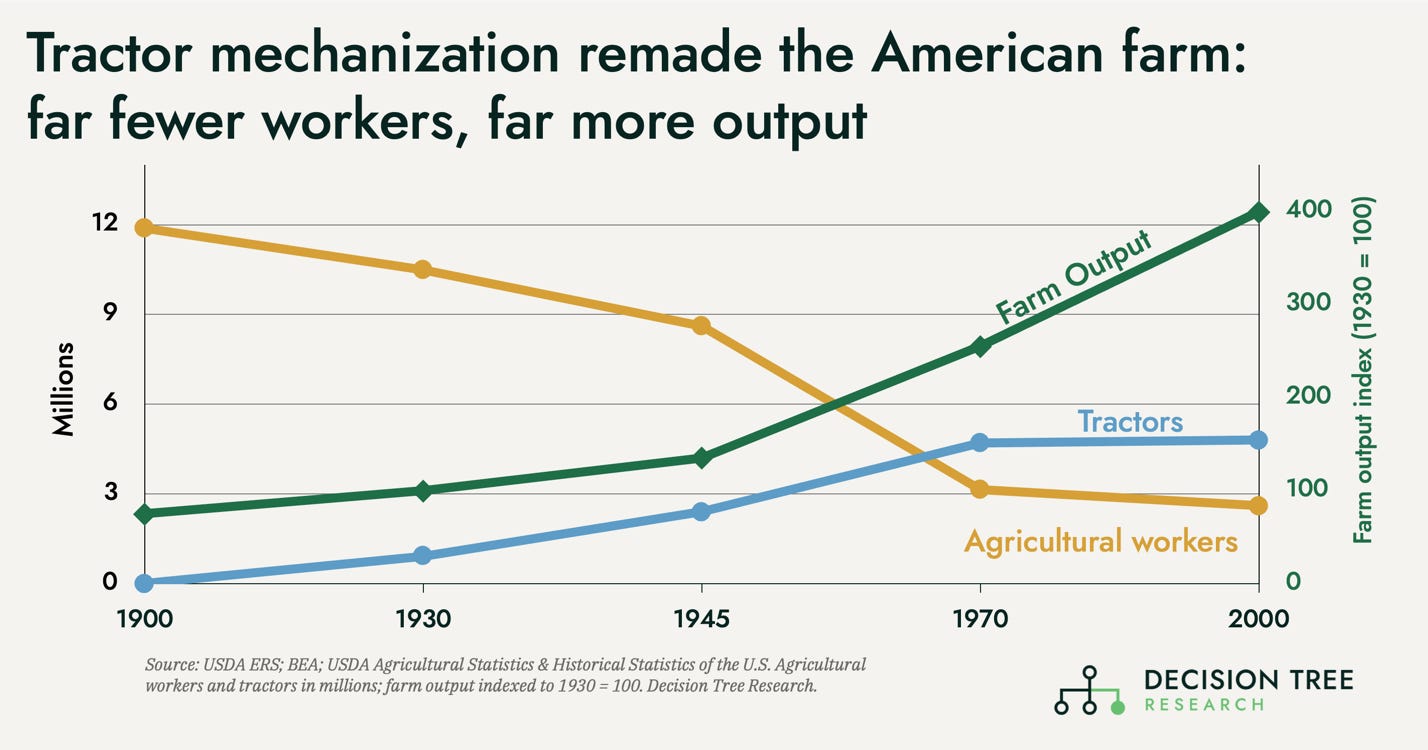
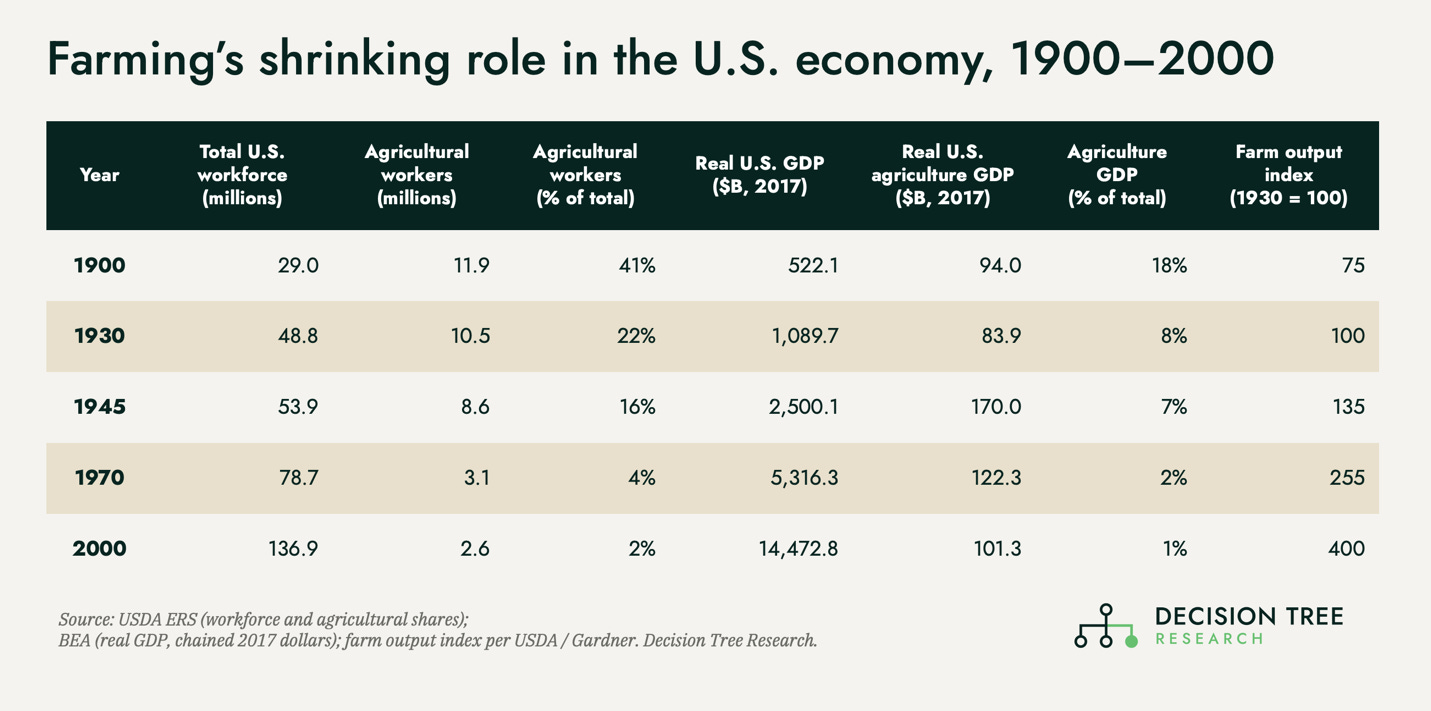
The increased productivity story comes down to three main factors:
1) Automation: Growing adoption of tractors (and later mechanical pickers) which increased in both number and per-tractor power. Tractors were not only stronger and faster than the animals and men they replaced: they also freed up the significant share of land on most farms reserved for growing food to feed working horses and mules;
2) Sector reorganization: Consolidation of many small farms into fewer, bigger, and more efficient farms; and
3) Introduction of modern farming techniques: Improvements in fertilizers, pesticides, crop strains, and irrigation.
Combined, these delivered astonishing gains in U.S. agricultural productivity, providing more food, more cheaply. That’s the good news.
The bad news is that the agricultural workforce shrank by nearly 9 million.
A 1937 Dorothea Lange Photo captioned by the Department of Agriculture. The caption reads “Texas tenant farmers who have been displaced from their land by tractor farming.”
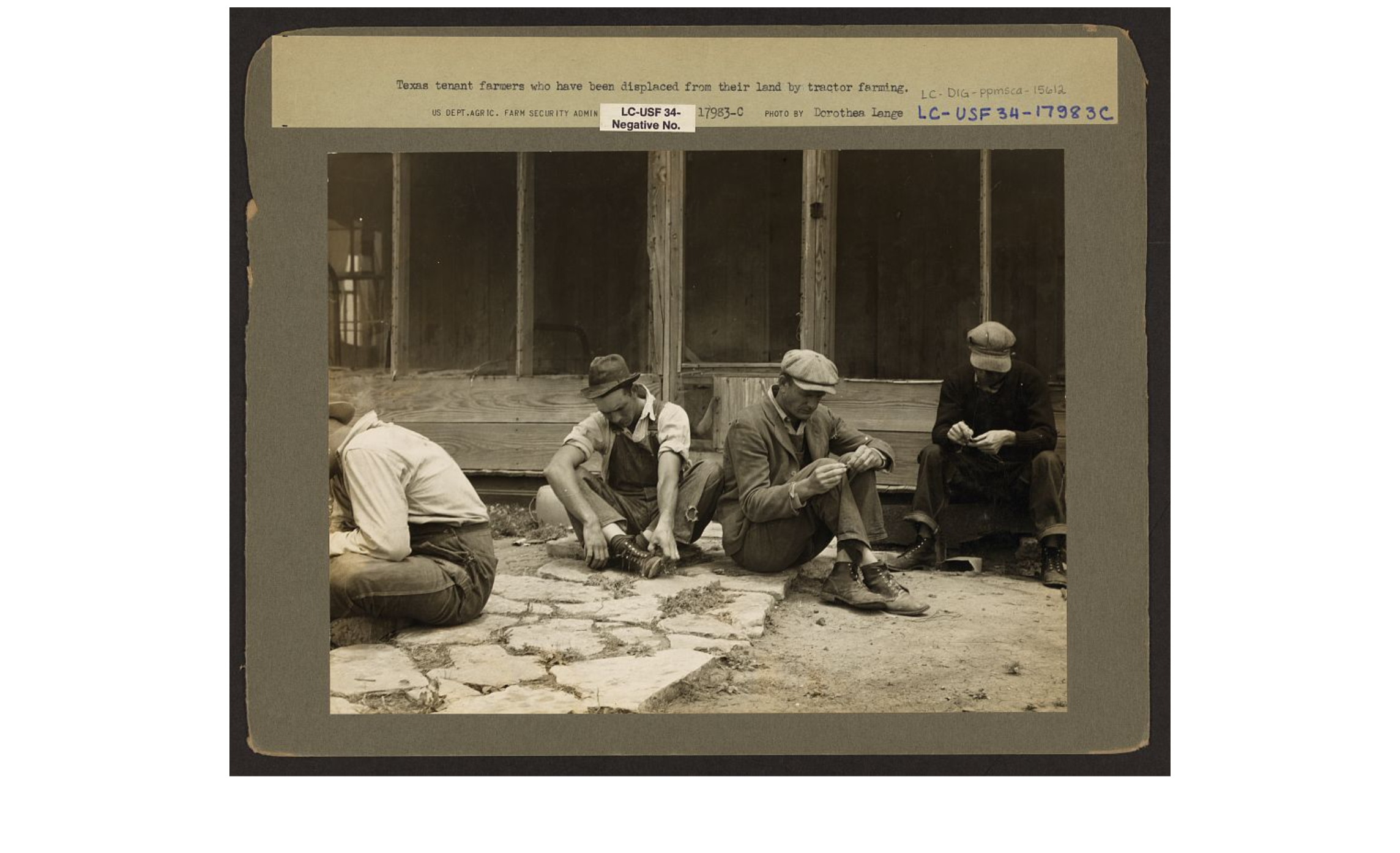
The most remarkable part of the story, however, is that overall American unemployment was basically unaffected. Those 9 million workers successfully shifted from jobs in agriculture to jobs in the booming industrial and service sectors.
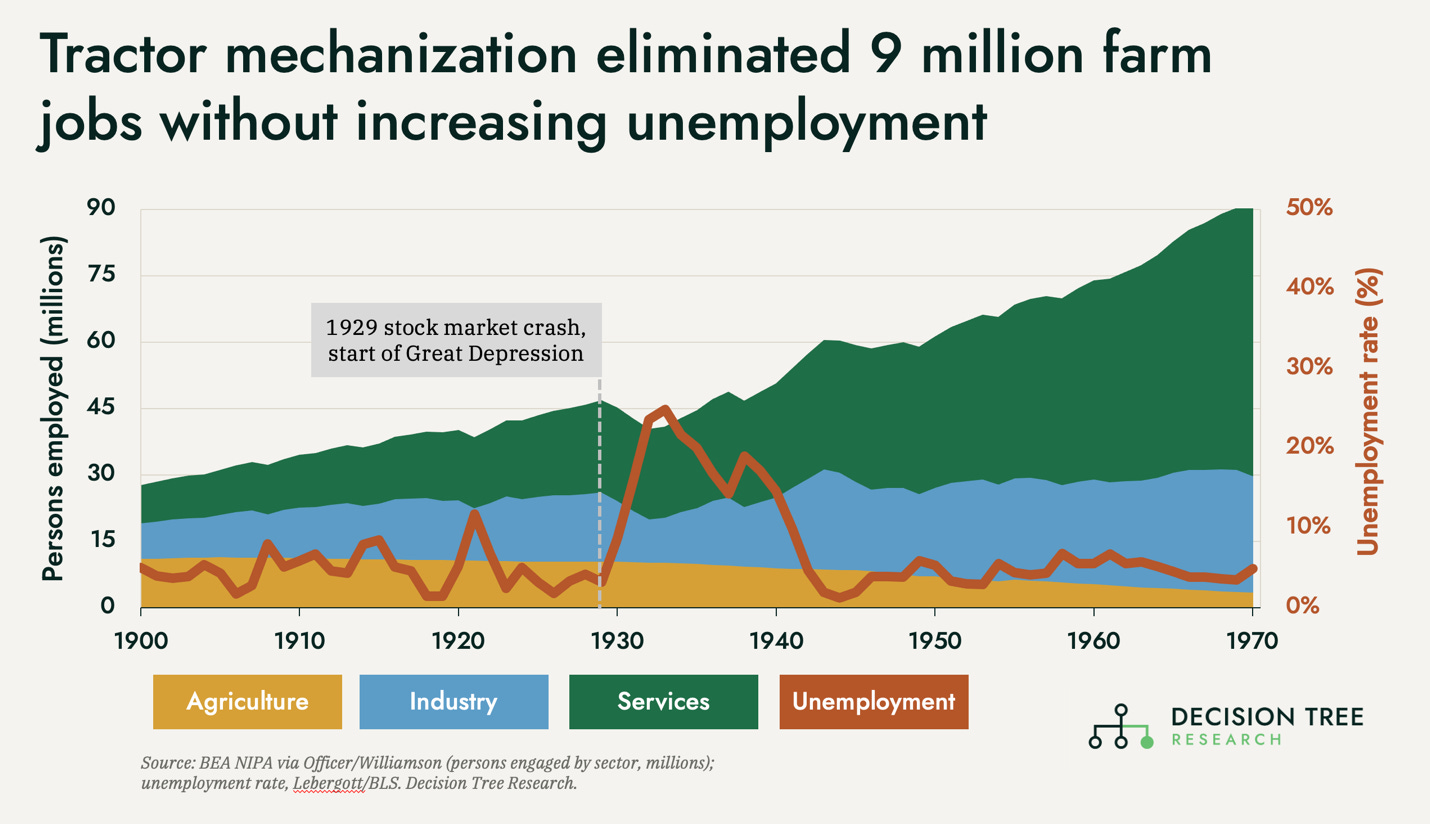
These two trends—booming farm productivity and rising non-farm labor demand—aren’t a coincidence: they’re the same trend seen from opposite ends. When mechanization made food vastly cheaper, American households didn’t respond by eating vastly more. There’s only so much a stomach can hold. Instead, Americans spent the savings on everything else, first manufactured goods and later services. The shift is stark in the data: in 1901 Americans spent 42.5% of their expenditures on food; by 1970, it was 19.3%. Every percentage point that fell off the national food bill reappeared as demand — and jobs — somewhere else.
Key insight for AI: automation can drive job losses in a specific sector without meaningfully contributing to overall unemployment.
Over the past year there has been a wave of companies, mostly in software, announcing layoffs as part of a strategy of replacing workers with AI. At the same time, economists are scouring every new batch of unemployment data looking for evidence that AI is driving job loss in specific sectors. The early 20th century story of farm automation, however, tells us that even if a productivity-enhancing technology does drive unemployment in a specific sector or job category, the savings from that productivity still cycle back into the overall economy and labor demand. AI might be short-term painful for specifically affected groups of workers or geographies, but we should not confuse that with evidence that AI is driving up long-term unemployment.
Agriculture Part 2: Demand Elasticity
How much more can you eat?
There’s a key aspect of the early 20th century tractor revolution in the U.S. agriculture sector—and particularly the food part of the agriculture sector—that I only touched on briefly in the first section: there’s only so much a stomach can hold. In more general terms, an increase in a sector’s supply potential does not automatically mean that there will be adequate demand to absorb the increased production.
Conceptually, a big increase in per-worker productivity can be “spent” in two ways:
Fewer workers to produce the same (or greater) output
More production with the same (or greater) number of workers
20th century food production falls into the first category, but the second story has also played out in the U.S. agricultural sector. It happened more than two centuries ago with the invention of the cotton gin by Eli Whitney in 1793.
What is a cotton gin? It’s the machine that separates cotton seeds from cotton fiber. The reason why the cotton plant grows those white tufty balls of cotton fiber is to catch the wind and disperse the plant’s seeds. Dandelion flowers evolved a different version of the same trick. But cotton seeds are much bigger and tougher than dandelion seeds, so the seeds have to be removed from raw cotton before the fiber can be processed into textiles.
Before the invention of the cotton gin, separating the seeds from the tightly attached fibers of short-staple cotton (the kind that grows in the climate of the American South) was a slow, labor-intensive affair. A single worker could typically remove the seeds from only 1 pound of raw cotton per day. The costs were high enough that growing cotton in the South was, for the most part, economically non-viable, even with slave labor. Whitney’s cotton gin increased the per-worker processing output to 50 pounds per day, a 50-fold improvement in productivity. But the cotton gin did nothing to automate growing and picking, which stayed entirely manual. Picking would continue to require the dexterous human hand (a huge human advantage!) for another 150 years.
The cotton gin smashed the deseeding bottleneck while making every pound of picked cotton far more valuable. It also made cultivation of Southern short-staple cotton suddenly profitable, opening an enormous new growing region. The massive decrease in the cost of a complementary service (deseeding) drove an explosion in demand for the field labor the gin didn’t replace. Specifically, the gin increased demand for enslaved labor.
It is no exaggeration to say that the cotton gin changed the course of history for slavery in America. Part of the reason why some of America’s founding fathers thought (perhaps naively) that slavery would die out naturally was that southern agricultural slavery wasn’t actually all that profitable and faced unclear future prospects. Chesapeake tobacco was exhausting soils and facing sustained low prices, such that many farms were switching to growing far less labor-intensive crops like wheat and sometimes freeing slaves in the process.
The cotton gin changed all of that. Labor was now desperately needed.
So why did 20th century tractors reduce demand for farm labor while 19th century cotton gins increased demand for farm labor? The explanation lies not on the supply side, but on the demand side. In response to increased availability of cheaper food, people can eat more, but only to a certain point. An adequately fed person can perhaps double the amount that they eat per year, but they cannot increase the amount that they eat by 50-fold. Their stomachs would explode.
By contrast, consumers (including those outside the United States) could and did increase their consumption of cotton by more than 50-fold. In fact, U.S. cotton production increased 1000-fold from about 3,000 bales in 1790 (nearly all of which was long-staple cotton that wouldn’t grow in the Deep South) to 3.8 million bales in 1860—all of it happily purchased to meet near-insatiable demand. The short-staple cotton crop that wasn’t worth growing before 1793 became the dominant fiber of the world.
How? The American cotton gin (combined with a near-simultaneous British revolution in mechanized spinning) caused one of the steepest price collapses in economic history. The price of one pound of cotton yarn fell by 95% between 1784 and 1832. Quite rapidly, cotton went from a semi-luxury to the cheapest fabric on earth. As a result, cotton displaced wool and linen as the everyday fabric for most people.
Before the cotton gin, wool and linen were expensive but the only real options for most clothing. Common people might own only a few sets of clothing or perhaps just one. After the cotton gin, the common wardrobe went from sparse, durable, and rarely washed wool and linen to abundant, varied, and laundered cotton. You can guess what happened to employment in the English wool industry.
Average Americans could suddenly afford to enjoy the thrills of following fashion, buying new clothes to match changing tastes. Moreover, household textiles that had previously been luxuries—bedsheets, curtains, towels, tablecloths—became affordable cotton goods. Finally, cotton expanded to industrial and other uses: thread, bags, and eventually bandages.
This is the essence of the economic concept of demand elasticity. How much does market demand change in response to a change in supply and price? Food demand was relatively inelastic: a big decrease in prices didn’t cause a big shift in how much people ate. By contrast, cotton demand was highly elastic: the 20-fold drop in cotton prices caused a far, far greater increase in cotton demand.
Cotton growers didn’t just expand production with the existing labor pool: they also increased the size of the labor pool (almost entirely slaves) and acquired more land for cotton cultivation. Production exploded.
As a side note, the Southern short-staple cotton industry was not profitable even with slave labor before the cotton gin, and slavery wasn’t necessary to make cotton profitable after the invention of the cotton gin. Within fifteen years of abolition, the South was growing and exporting more cotton than it had under slavery. What slavery provided was not viability but coerced, below-market-rate labor and thus extra profit for landowners.
Key insight for AI: whether automation leads to job losses or job growth in a sector depends heavily on that sector’s demand elasticity.
Put simply, how much more will consumers buy if prices go down? We appear to already be experiencing a version of this in the software sector. Today’s AI-coding systems are excellent at producing many kinds of computer code, but demand for some kinds of software engineers (especially at companies making AI) is increasing.
The reason is that demand for software appears to be highly elastic. People can’t increase how much they eat by 50-fold, but consumers, businesses, and the government might be happy consuming 50 times more software if creating and changing custom software is ridiculously cheap and convenient. And as long as humans are still needed for some part of creating software—at least for now—overall demand for software engineers might go up, not down.
Human software engineers can move to higher-level tasks (design, planning, oversight) while machines handle churning out the raw code. The data on this is not yet crystal clear, but anecdotes about how experienced software engineers are in higher demand than ever while entry-level software job openings have cratered are consistent with this interpretation. The challenges of that potentially bifurcated outcome will be addressed in the Music and Chess case studies below.
Horses Part 1: The Limits of Retraining and Labor Mobility
Horses can’t work in hospitals
In the first section, we saw that the introduction of the tractor led human farm employment to crash. Despite major sectoral pain and disruption, there was no aggregate impact on human unemployment. But the key word in that claim turns out to be “human.” There was a different farm labor population for whom the introduction of the tractor did lead to large population-level increases in permanent unemployment: horses and mules.
Today it might seem silly, but in the 19th and early 20th centuries, economists had no trouble thinking of horses and mules as part of the labor force. In 1915, the American economy still ran on hooves. The United States was home to roughly 26 million horses and mules, about one for every four people, and they were not pets. They pulled the plows, hauled the freight, pumped the water, and powered the streetcars. The federal government counted them the way it counted any other input to production: the Census Bureau tracked the nation’s working horses and mules, herd by herd, year after year, until 1960. They stopped because horses and mules stopped being economically important.
When the Bureau stopped counting, about 90% of that population was gone (dead, not merely unemployed) — displaced not by a war or a plague but by a machine.
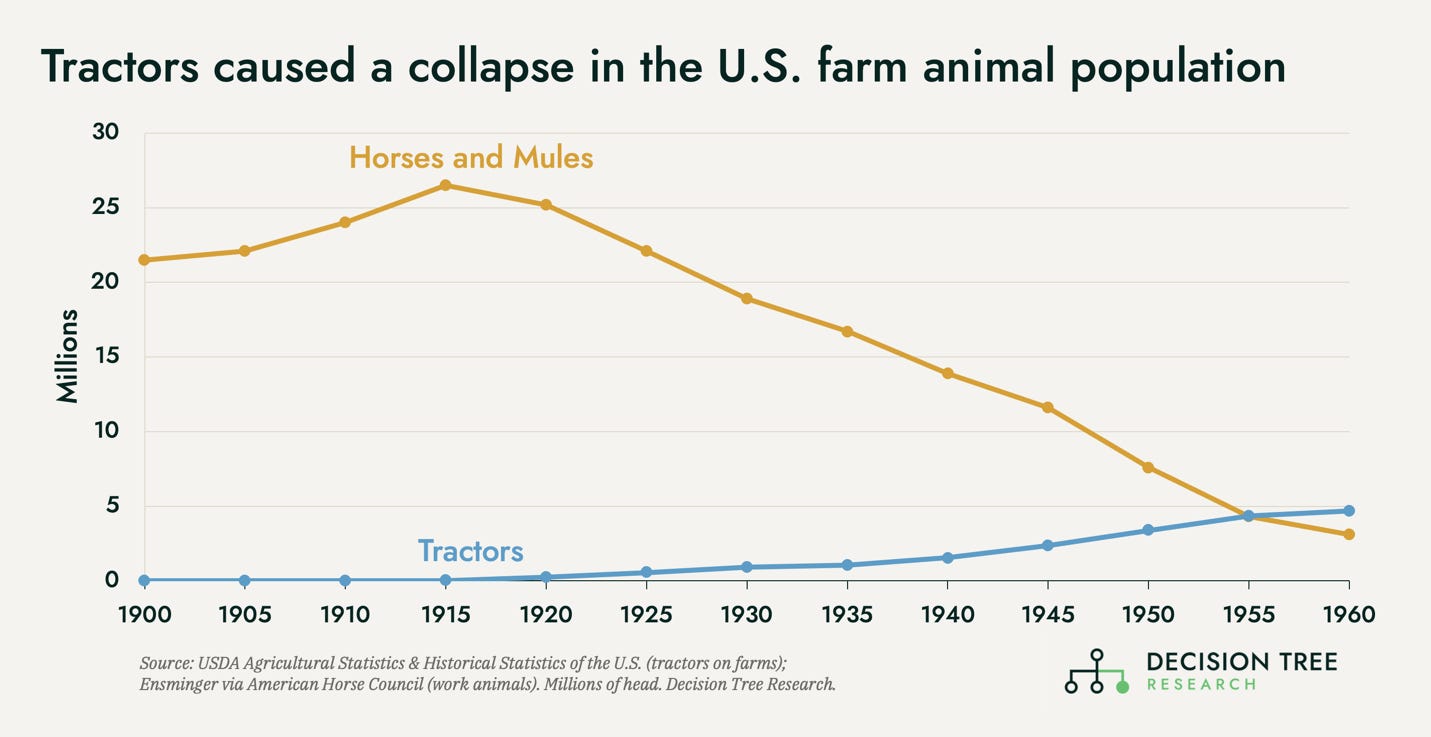
Why didn’t the horses follow their human coworkers into the factories and the offices? In short, because they had nothing to sell that employers wanted. A horse offers physical power, not mental power, and by the 1920s, machines offered more power, more cheaply, and more precisely in every task a horse could do. And for the parts of the economy where machines weren’t yet superior in every way to horses, humans were. A horse can’t run a drill press (no dexterous hands), can’t converse with customers (no vocal cords), and can’t handle bookkeeping (no big brain). When the machine beat the animal on both price and performance, the demand curve for horse labor didn’t shift to some new sector. It fell off a cliff.
According to economic theory, in a functioning market there is always some wage low enough that a worker gets hired. That is the logic behind comparative advantage, and it’s one of the standard reasons economists insist automation can’t cause permanent mass unemployment: even if machines have an absolute advantage and are better at everything, humans can accept jobs at lower and lower wages until employing them somewhere is still worthwhile, and the market clears. The horse example provides the asterisk on that theorem. There was, in fact, a theoretical wage at which a horse was still worth employing. The problem was that this theoretical wage had fallen below the cost of feeding and stabling the horse. Comparative advantage guarantees that some theoretical wage exists; it does not guarantee that the price covers the cost of staying alive. When it doesn’t, you don’t get unemployment. You get the glue factory.
And the glue factory is roughly what happened. The surplus horses were slaughtered — for meat, for pet food (horse meat was a staple of canned dog food well into the 20th century), and yes, rendered into glue and fertilizer. The rest simply weren’t allowed to have offspring. A working population of 26 million was culled to about 3 million in 45 years.
Key insight for AI: Even if increasing automation in one area of the economy leads to increased demand for labor in other areas, there is no guarantee that the automation-displaced workforce will be able to meet the new demand.
Much of the policy conversation on AI job displacement focuses on retraining displaced workers for new jobs. According to some reporting on this, a cohort of AI-spooked Gen Z students is forsaking college and its weakening promise of post-graduation knowledge work to learn blue-collar trades (plumbing, carpentry, welding, etc.) that appear unlikely to be automated anytime soon. This may be a perfectly reasonable approach to handling an AI transition period in which humans still have employable strengths in areas where machines still have weaknesses. However, horses demand that we confront the harder case: what if at some point AI enables machines that are legitimately better and cheaper at everything that humans can do?
There are at least two answers to this question. First, if AI leads to a total collapse in employable labor and wages, humans might still have other potential sources of non-wage income, including from returns to owned capital (horses can’t own property) and from government redistribution (horses didn’t have a large voting population calling for new social safety nets). The second answer is covered in the next section.
Horses Part 2: The Relational Economy
Why mules had it much worse than horses
There’s a twist that should give an AI-anxious human a little comfort: the horses did not go extinct. The population bottomed out around 1960 and then did something strange — it grew back. Today there are 6.6 million horses in the United States, more than double the low point. Almost none of them “work” in the 1900s sense of that word. They are shown, raced, ridden for pleasure, and adored. By the American Horse Council’s reckoning, something like two in five American horses are competitive athletes — a show jumper, a barrel racer, a Thoroughbred — and most of the rest are pleasure and companion animals. An entire economy, worth well over a hundred billion dollars a year, now exists to keep horses around purely because humans like having them around—even though they’re slower than dirt bikes.
So, what are all these horses doing? 92% of them are devoted to three activities:
Recreation (trail, pleasure, backyard)
Showing (competitive show horses)
Racing (both active and for breeding stock)
True working horses (mounted police units, carriage operations, equine-assisted therapy programs, and lesson programs) are only 8% of the population, and even there it’s debatable whether horses are truly “best” for the job, or just sentimentally preferred.
That is the optimistic horse story: their economic value was almost entirely annihilated, but then a second life was born as a sort of luxury good. Horses are “workers” in a luxury industry that exists specifically because of intrinsic consumer preferences about who the workers are.
Now here’s the pessimistic horse story: mules — the sterile, sturdy, deeply unglamorous donkey-horse hybrids that did much of the South’s plowing. The U.S. mule population peaked at nearly 6 million in 1925. Today, there are perhaps 20-30 thousand in the United States.
That’s not a count of how many are working: it’s how many are left alive. Mules experienced a 99.5% population collapse with no rebound.
Why did the horse get a luxury second act and the mule didn’t? Because the mule’s only value was work. No one enters a mule in the Kentucky Derby; there is no mule dressage at the Olympics. In America, little girls might dream of someday owning a pony, but practically none dream of owning a mule. Strip out the mechanical utility and there’s no consumption demand left to catch the fall.
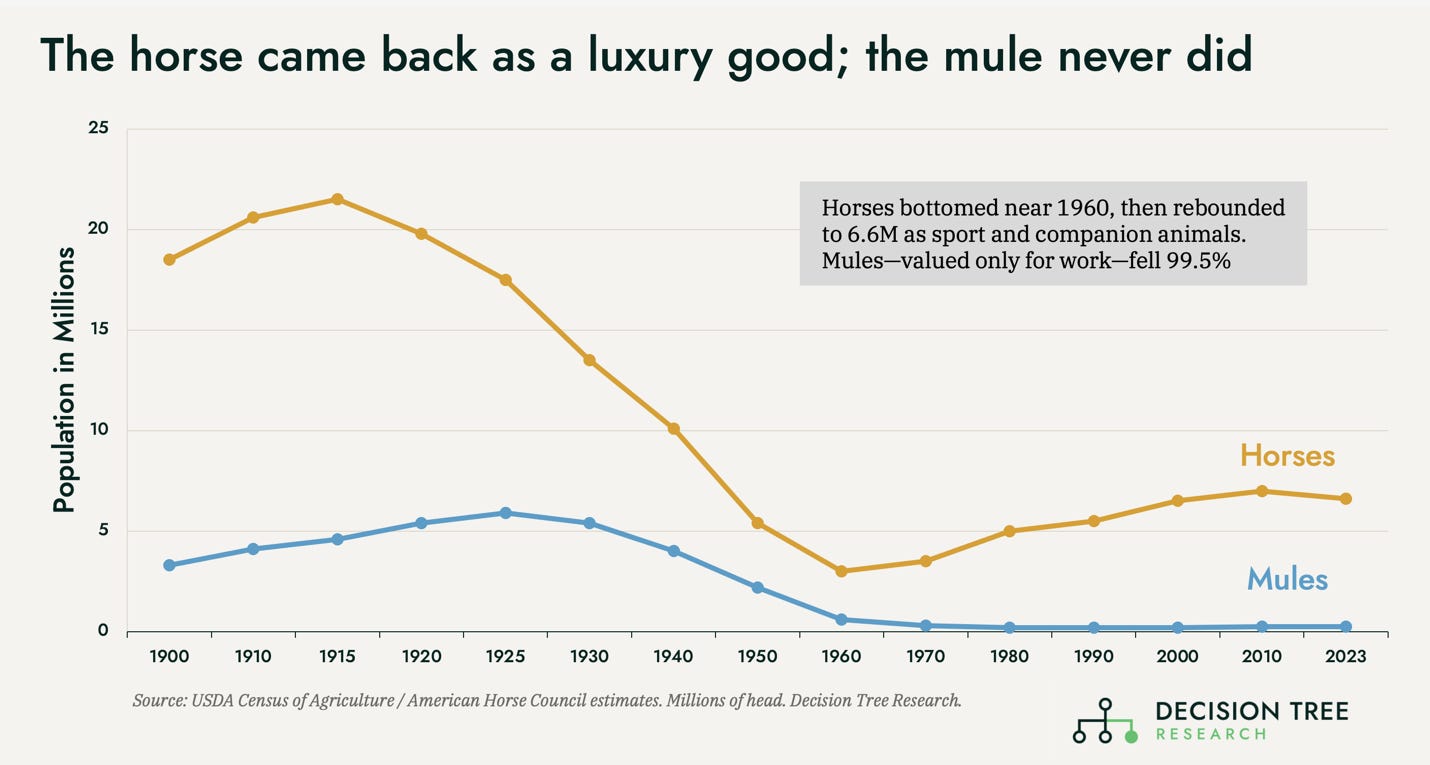
Survival after absolute functional displacement depends on residual consumption demand — on whether anyone wants what you provide because you provide it. After the 1960 low point, horses still had charisma, sport, and beauty, and they got a hundred-billion-dollar leisure economy. Ugly, stubborn mules had only output, and they got turned into glue, leather, and dog food. Then they were mostly forgotten (at least in the United States).
Key insight for AI: Arbitrary preferences can sustain “relational economy” demand for human labor if consumers intrinsically care about the source and nature of the labor.
The human version of this sorting is already visible: we will likely keep paying a premium for many kinds of human-made objects and human-performed services — live music, craft, care, the handmade, the “a person did this” — long after a machine could reproduce them, sometimes even at superior quality. A group of economists, including Alex Imas, the director of AGI Economics at Google DeepMind, call this “relational economy,” and it’s perhaps the most optimistic scenario for how humans might still earn wages even in a world where machines are stronger, more dexterous, and smarter than humans in every way. The hopeful future for human labor may look less like the much-hyped “everyone becomes a blue-collar worker” scenario (do you really care that your plumber is a person?) and more like “two in five horses are competitive athletes.”
It bears repeating, however: the “horse rebound as a luxury” story happened after the 90% horse population collapse. For humans, the post-AI relational economy will almost certainly exist to some degree, but whether it will be big enough to employ all the workers who want a job at livable wages is deeply uncertain. We’ll explore this question in the Music and Chess case studies.
Music: Automation vs. Augmentation and Superstar economics
Winners take all
Tractors and cotton gins gave history-shaping boosts to productivity in the agriculture sector, but they pale in comparison to the productivity gains related to copying and transmitting data. The cotton gin’s 50-fold improvement in productivity is nothing compared to the printing press or digital music, which increased the output of text and audio performances by millions or billions of times.
A very loud, unamplified medieval singer could still only perform to people within earshot, perhaps a thousand people in a large, acoustically well-designed cathedral. By contrast, during the 1985 Live Aid concert, which was broadcast around the world, perhaps 1.5 billion people listened to Freddie Mercury of Queen sing in a single day. Freddie Mercury’s voice could reach a million times more people. Now that’s augmentation! And Freddie’s limiting factor was not the technology, but the ability to attract an audience. The actual scaling factor is almost unlimited.
Just like cotton, perhaps more so, demand for music is highly elastic. As microphones, radios, record players, and eventually MP3 players made music ever cheaper and more convenient to enjoy, people consumed a lot more of it.
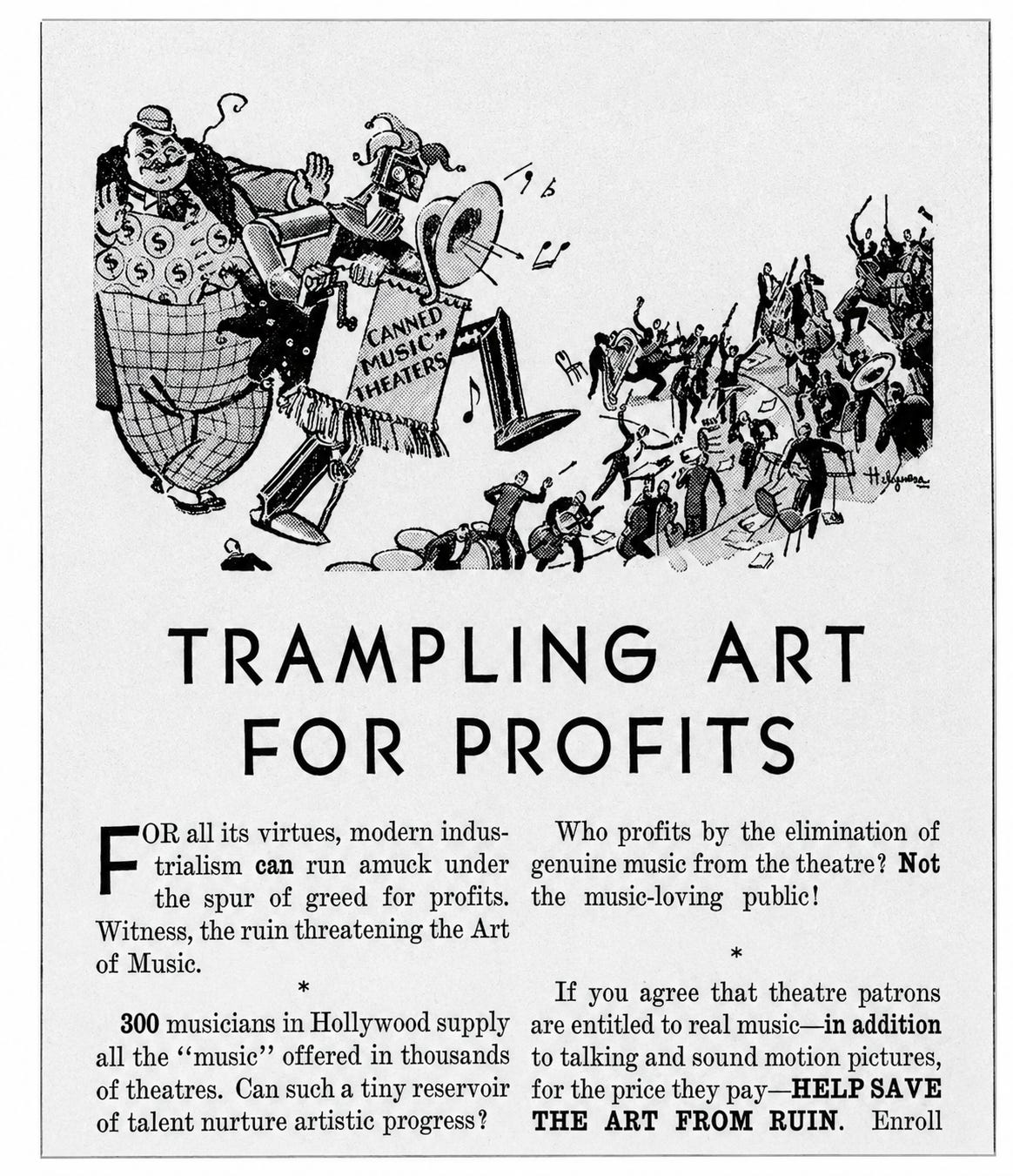
So, what happened to professional musicians? Well, there was certainly a lot of job loss. Predictably, this created musical versions of the Luddite movement. For example, before synchronized sound arrived in film in 1927, all music in movie theaters was provided by a live band. In 1930, the 22,000 live musicians who traditionally performed the music that accompanied “silent” movies were thrown out of work by the adoption of what they called “canned music.” According to the anti-robot advertisements they ran in newspapers around the country, canned music would allow “300 musicians in Hollywood [to] supply all the ‘music’ offered in thousands of theatres.”
The musicians’ union’s ads were quite creative in pursuit of a kind of “relational economy” edge, but they were not enough to persuade the movie-going public to care. Elastic demand for the output didn’t translate into demand for the workers, because the output could be reproduced infinitely without most of them.
But even for those musicians who managed to keep their jobs, the situation resembled the opening of Charles Dickens’ novel A Tale of Two Cities: “It was the best of times, it was the worst of times.” The invention of high-quality recorded music led to a major split in incomes among professional musicians, with the most successful musicians’ incomes exploding and the average musician’s plummeting (among those that kept their job at all).
In economics, this is called the superstar phenomenon, a “winner-take-all” outcome that allows a small subset of the producers—hugely augmented—to meet nearly all the demand.
There are two ingredients required for the superstar effect to apply:
Imperfect substitution in demand: where lesser talent (even a lot of it) is a poor substitute for greater talent. Think about it this way: if decently performed music is rare, as it was before the invention of recorded music, then a local musician of any talent at all is a real treat. However, if music can be recorded and re-played infinitely, why would you listen to any but the best musicians who play your favorite style of music? If you like classical cello music, would you rather hear ten recordings of ten average high-school cellists or one piece performed by the cello master Yo-Yo Ma?
Large economies of scale in distribution (also called joint-consumption technology) such that providing the product or service costs about the same whether ten or ten million people consume it.
The superstar effect offers an important caveat to the idea that workers in sectors where demand is highly elastic will be safe. With modern music streaming services like Spotify, people today can listen to almost anything, around the clock, at a marginal cost near zero. Music consumption has exploded into the trillions of streams per year. However, about 90% of music streams are for songs produced by the top 1% of artists. Perhaps the most extreme version of the music superstar effect is The Beatles in the first three months of 1964. During that period, six out of every ten records sold in the United States were by The Beatles.
Key insight for AI: The much-hyped automation vs. augmentation distinction doesn’t do much to clarify whether AI will create or destroy jobs in a given sector. Exclusively “augmentation” technologies might still result in both high job loss and extreme income inequality among workers in that same sector.
Chess: Centaur Economics
Mere humans can help superhuman AI, but who knows for how long
In 2005, a website called PlayChess ran a “freestyle” tournament with one rule: bring whatever help you want. Grandmasters, AI chess engines, teams of grandmasters running multiple engines on serious hardware — all allowed. The favorites were exactly who you’d expect. The winners were not. First place went to two American amateurs, Steven Cramton and Zackary Stephen, with USCF chess ratings of 1685 and 1398 (not even expert level), hunched over a couple of ordinary PCs. They beat grandmasters, standalone chess supercomputers, and teams that included both.
Garry Kasparov, the former world champion who had been brooding on human-machine chess teams since famously losing to IBM’s Deep Blue in 1997, drew the lesson that would launch a thousand keynote slides. A weak human plus a machine plus a better collaboration process, he observed, was superior not only to a strong computer alone but to a team of strong humans and machines running an inferior process. The decisive skill was no longer exquisite chess. It was knowing how to collaborate with and manage your silicon partner. People started calling these hybrid teams “centaurs,” and “Kasparov’s Law” became the optimist’s favorite proof that AI would augment us rather than replace us. The future of work, the story went, was centaurs all the way down.
It’s a lovely story. Unfortunately for chess players, within three years it was conditional and narrow; within 12 it was over entirely.
Rewind to the setup. Deep Blue’s 1997 win over Kasparov was treated as a stunt — expensive custom supercomputer hardware beating one exhausted human. But AI chess engines never stopped improving. By the early 2000s an ordinary PC could play at elite grandmaster strength, and engine ratings kept rising straight through the human ceiling and out the other side. The strongest human chess player who ever lived, Magnus Carlsen, peaked at an Elo of 2882 in 2014; Kasparov topped out at 2851. Today’s top engine, Stockfish 18, is not rated on the FIDE Elo scale but would be off the chart. One has to occasionally lose a game to the (in FIDE’s case exclusively human) competition pool to correctly calculate Elo, and Stockfish never would.
Today’s Stockfish is so far beyond Carlsen that across a thousand games he would lose nearly all of them, manage only the rarest draw (with some luck), and never once win. In a recent podcast interview, Carlsen himself said that he would have “no chance” competing against the chess app on his phone.
Even at its 2008 height, the centaur advantage was conditional. In blitz (with only three to five minutes of total thinking time per side), the human added nothing. In hour-long games, the human-machine team didn’t clearly beat the machine alone. Only at the very longest time controls — where a person had room to second-guess the engine and occasionally catch something — did centaurs reliably win. The window was real, but it was narrow even while it was open.
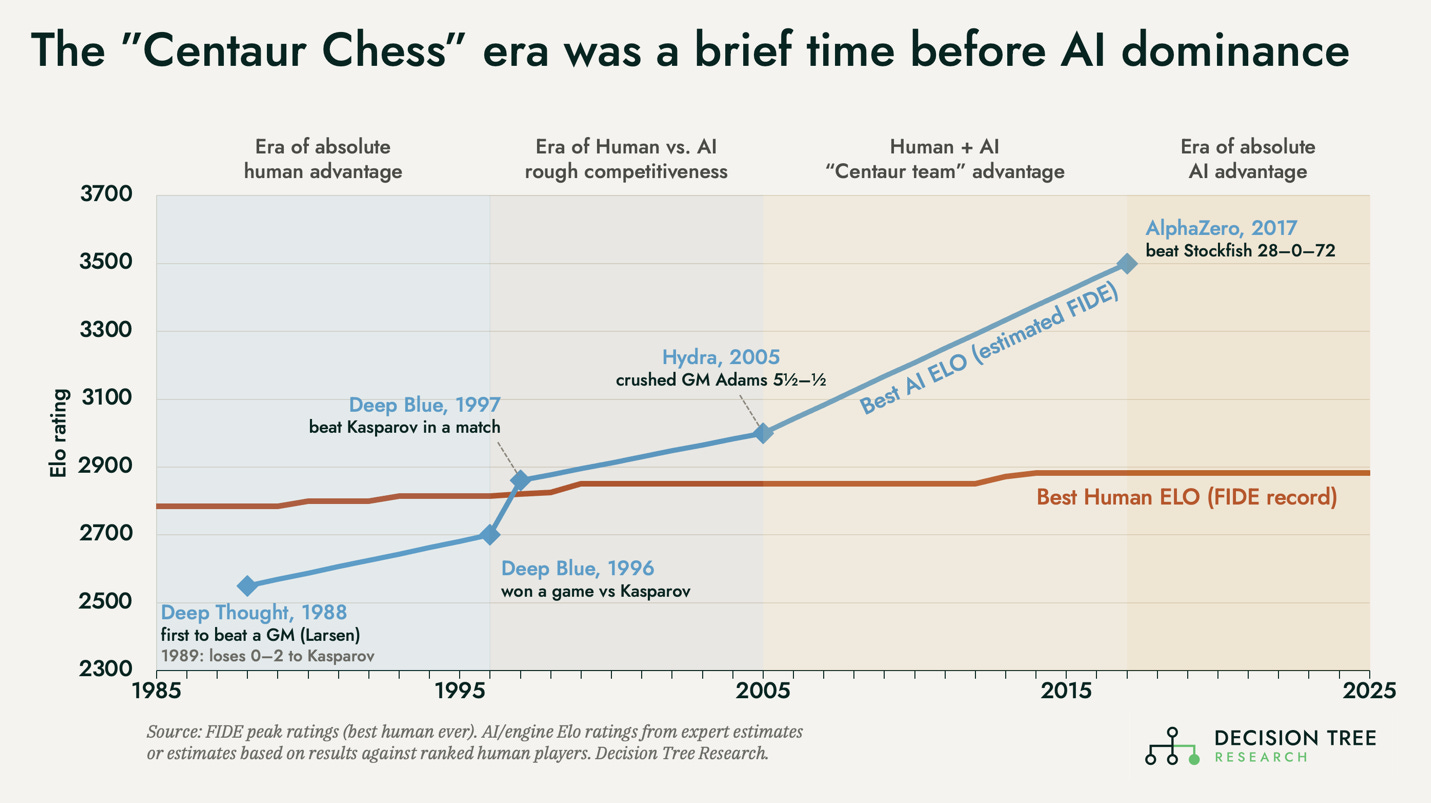
As the engines pulled away after 2009, the human’s job shrank to a single task: deciding which engine to trust when two top programs disagreed. Then even that window closed by 2017. The blunt version, now conventional wisdom among strong players, is that human intervention yields only negative returns — override Stockfish or its top AI competitors today and you are almost certainly introducing a mistake. The centaur did not evolve into a higher being. The human half became a handicap.
That is the pattern worth watching for in other domains. For a brief, real moment, the best way to play chess was a human and a machine together. That moment was not the destination. It was a waypoint on the road from “machines can’t” to “machines do it better without us.” Optimists thought that the centaur chess era looked like the future of work. If they were right, the future of work isn’t a very hopeful picture. The centaur chess era was brief and, even at its peak, not that reassuring.
Of course, both the relational economy and the superstar phenomenon are still at work in professional chess. In general, humans want to watch humans play chess, not AIs, so there are lots of tournaments with prize money for human players, and no prize money for AI-versus-AI tournaments. But the distribution of human chess earnings is overwhelmingly concentrated at the top. In 2025, Magnus Carlsen earned nearly $1.5 million in chess tournament winnings, plus millions more from sponsorships and appearance fees. Yet only 26 professional chess players earned more than $100,000 in 2025. And for everyone outside the elite, there’s no big hidden sponsorship upside: prize money is most of it.
Key insight for AI: A period in which humans and AI work better together than either does alone is not evidence that the partnership will last.
It may be nothing more than the short overlap between the moment a machine gets good enough to help and the moment it gets good enough to work alone. Plan for the collaboration. Don’t bet your career on its permanence. We may be in the peak centaur era of software development right now. How long it will last is deeply unclear.
This is also where the comforting analogies from the earlier sections begin to run out. The displaced farmhands had factories and offices to shift to. The horses got a luxury second act because some people happen to love them (even if others prefer dirt bikes). In some circumstances, live musicians still have the “a human made this” premium based on an arbitrary (but potentially durable) consumer preference. Every one of those escape routes depends on humans keeping some edge — a new sector, a buyer who cares who did the work. Centaur chess is the cautionary tale because it shows what’s left when the last human edge is collaboration itself, and then that goes too. And to the extent that the relational economy offers an island of safety, that may be a small island with room for only a few superstars.
“How to love people who have no use?”
I started this essay with one Vonnegut novel, so let me end with another.
I’m in the camp that thinks that, given enough time (maybe a decade, maybe a century), AI will be able to do nearly everything humans can do that has economic value not rooted in an arbitrary, intrinsic preference for a human doing it. In Player Piano, even the engineers and managers who built the machines eventually became surplus.
But in God Bless You, Mr. Rosewater, Vonnegut posed what I think is the question sitting underneath all four of these case studies: “How to love people who have no use?” The horses had charisma, sport, and beauty, so we loved and kept them. The mules had only their labor, so we didn’t. Strip out the economic value, and what’s left is whatever we’ve decided is worth keeping for its own sake.
Vonnegut had an answer. Later in that same novel, as a benediction over newborns, he delivered it with characteristic bluntness: “There’s only one rule that I know of, babies — ‘God damn it, you’ve got to be kind.’”
It isn’t an economic policy. It may not be much. But in a world where fewer and fewer of us are useful in the old sense, it might be the only thing that scales.