


Two recent reports from The Information (July 27) and Reuters (July 28) claim that China has reached an important milestone in local production of a key type of semiconductor manufacturing equipment, Deep Ultraviolet (DUV) lithography tools. Specifically, Reuters claims that Shanghai Aishengna Electronic Technology Group, a Chinese state-owned company, has begun volume production of immersion DUV lithography tools, with The Information reporting that the company expects to ship 5 machines this year and 20 machines next year. Worldwide, the Dutch company ASML has a monopoly on EUV lithography machines and a near-monopoly on immersion DUV machines. These reports are anonymously but credibly sourced. However, much remains uncertain about the situation and its near-term implications. This article will place the reports in context and assess the strategic implications of China’s technological progress in semiconductor lithography. For ease of navigation, the article is structured in a Q&A format addressing the following questions:
What is a DUV immersion Lithography Machine?
What is the strategic importance of DUV immersion Lithography Machines to China?
How much are U.S. export controls to blame for China’s pursuit of “self-sufficiency” in DUV immersion Lithography?
How likely is it that reports of Chinese progress in immersion DUV lithography are accurate?
How many immersion DUV machines can China make? How close does that bring China to its goal of self-sufficiency?
Are China’s immersion DUV machines competitive with those of ASML?
Can Chinese chipmakers produce advanced AI chips using ASML’s immersion DUV machines?
Can Chinese chipmakers produce advanced AI chips using locally-manufactured immersion DUV machines?
What is the U.S. government’s policy on China buying vs. locally producing immersion DUV lithography machines?
What Would the MATCH Act Do About This?
Conclusion: How big is China’s reported DUV semiconductor lithography breakthrough?
1. What is a DUV immersion lithography machine?
A modern chip factory (aka “fab”) requires many different kinds of extremely precise and complicated machines. The ultimate goal in every chip fab is to turn blank silicon wafer discs into processed wafers with many finished chips printed on top of each wafer. Lithography machines use light to “print” the circuit design onto the physical wafer. The features on modern circuit designs are measured in billionths of a meter (nanometers), and thus the machines must be extraordinarily precise.
The most advanced types of semiconductor lithography machines, called Extreme Ultraviolet (EUV) lithography machines, are almost unfathomably precise and have a credible case for being called the most advanced machines that humanity has ever made.
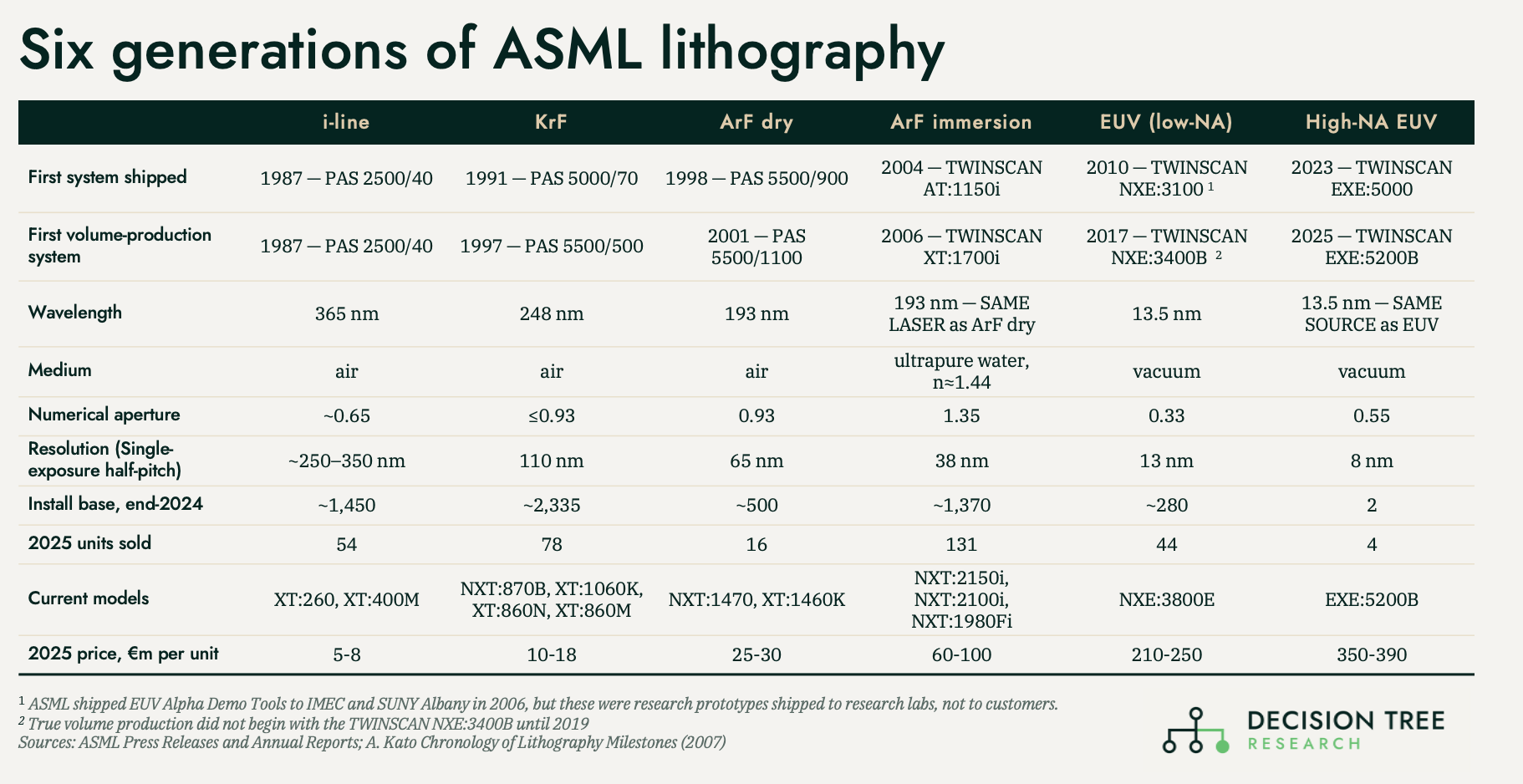
DUV immersion lithography machines are the generation of lithography machines that immediately preceded EUV machines. While there are different kinds of DUV machines, immersion DUV lithography machines are most accurately called Argon Fluoride immersion or “ArFi” lithography machines because of the argon fluoride chemical they use to generate the desired wavelength of light.
“Immersion” means a layer of ultrapure water sits between the final lens element and the wafer, raising the numerical aperture past the hard pre-immersion ceiling of 1.0. Explaining the meaning of numerical aperture is beyond the scope of this article, but suffice it to say that having a small pool of water touching both the lens and the portion of the wafer being printed upon meaningfully shrinks the size of the smallest features that the DUV lithography machines can print (improved resolution). The engineering enabling this is not merely a matter of “just add water.” Going from “dry” ArF to ArF immersion meant redesigning nearly everything inside the lithography machine.
Immersion DUV lithography was began testing in customer fabs in 2004. China likely imported its first immersion DUV lithography machine in 2008, likely from ASML. Despite being older and lower resolution than EUV machines, immersion DUV machines remain the workhorse of the industry and the best commercially available option for a wide range of chips — especially mature-node production, but also many non-critical layers on leading-edge chips. Immersion DUV machines remain commercially competitive and relevant for three major reasons:
Immersion DUV machines are far cheaper than EUV machines (~$60 million vs. $200-400 million);
EUV levels of resolution are unnecessary for making many types of chips that are still central to many commercial and industrial applications; and
Even on leading edge chips, not all layers require EUV levels of resolution. On layers that DUV can pattern in a single exposure, DUV offers higher throughput and lower cost per wafer — though on leading-edge layers requiring multi-patterning, that advantage reverses. Common practice for production on leading edge chips still uses EUV on only a minority of the layers.
The dominant global supplier of all types of semiconductor lithography systems is the Dutch company ASML, which is the monopoly supplier of EUV lithography machines, the near-monopoly supplier of immersion DUV lithography machines, and leading provider of nearly all the major older lithography machine types.
The different generations of lithography technology from the past 40 years are summarized in the table below. Even the older models of machines that ASML no longer manufactures continue to be used commercially as part of a vibrant resale and refurbishment market. ASML estimates that more than 90% of even its old models of I-line lithography machines are still in operational use somewhere in the world.
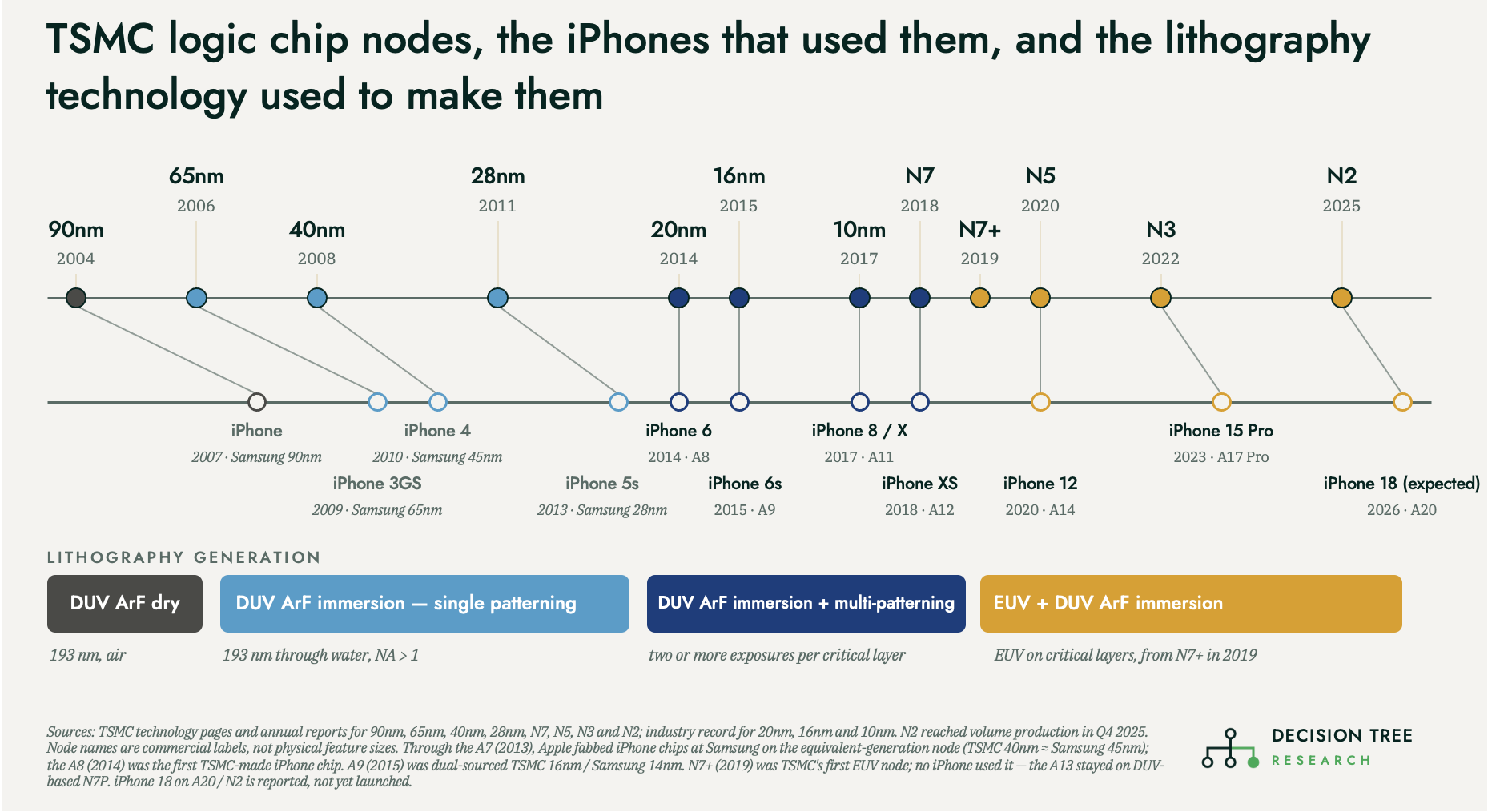
The semiconductor industry groups chips by manufacturing technology node, which names a certain era of manufacturing process and characterizes its performance and technical sophistication. The below timeline maps the logic chip nodes (using the TSMC naming conventions) since 90nm based on the type of lithography they used and the iPhones whose core application processor chips used those manufacturing processes. Note: Apple used Samsung as its iPhone chip manufacturer exclusively until 2014, and Samsung’s naming convention for each node generation differs somewhat from TSMC’s.
The key takeaway from this chart is that immersion DUV lithography technology was industry-leading from 2006 to 2018 and remains not only commercially relevant but essential even at the leading edge today.
2. What is the strategic importance of DUV Immersion Lithography Machines to China?
Semiconductors are a strategic industry and especially so for China. The analogy that “chips are the new oil” has its limits, but it is helpful to illustrate just how deeply woven semiconductors are into every aspect of the economy and how painful it is to lose reliable access to semiconductors. As one recent real-world example: the massive COVID-19 semiconductor supply chain disruption placed the economic importance of semiconductors in a spotlight reminiscent of an oil embargo. Analysis by the U.S. Department of Commerce found that “the [chip] shortage shaved an estimated $240 billion off U.S. GDP in 2021.” In other words, U.S. GDP was a full one percent lower than it would have otherwise been had the semiconductor shortage never occurred.
China is arguably the country most economically exposed to a loss of reliable access to semiconductors. By dollar value, China imports more semiconductors annually than it does oil, mostly as inputs for manufacturing products that are re-exported. China has long sought to increase its “self-reliance” in semiconductors by eliminating the need for foreign chip imports. This extends not just to making the chips that China’s economy needs, but also to making the machines that make those chips.
China’s official five-year plan adopted in October 2020 declared the semiconductor industry to be a top technology priority. The official summary of the CCP’s Central Committee meeting adopting the five-year plan was blunt: it stated that China would “make technological self-sufficiency a strategic pillar of national development.” At the time, Chinese policy recognized that the Chinese semiconductor equipment industry was not sufficiently technologically advanced to end China’s reliance on imports. But, China viewed equipment imports as a temporary waypoint on the path to technological self-sufficiency.
3. How much are U.S. export controls to blame for China’s pursuit of “self-sufficiency” in DUV immersion lithography?
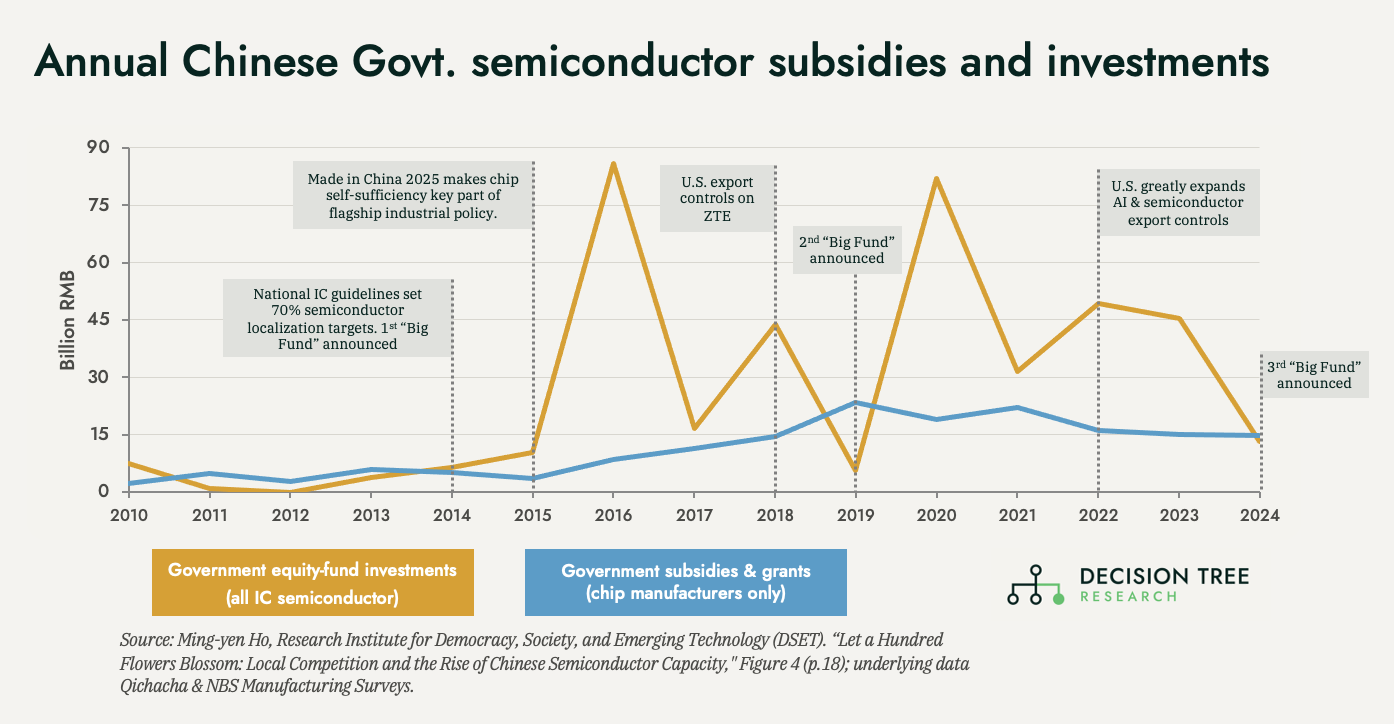
While it would be foolish to say that U.S. and allied semiconductor and semiconductor equipment export controls have had no impact on Chinese strategic thinking and planning, China’s goals for self-sufficiency long predate the modern era of U.S. semiconductor export controls that began in 2018 during the first Trump administration.
Three years earlier, in 2015, China announced its goals for self-sufficiency in semiconductors and semiconductor manufacturing equipment with its Made in China 2025 strategy. These goals specifically targeted:
Domestic production of immersion DUV lithography machines before 2025
Domestic production of EUV lithography equipment before 2030.
The roadmap document stated that
“meeting domestic market demand, improving the self-sufficiency rate of integrated circuit products, meeting national security needs, and occupying the strategic product market have always been the greatest demand and driving force for the development of the integrated circuit industry.” (emphasis added)
Even earlier policies, though less well resourced, sought to dramatically reduce use of foreign semiconductors and semiconductor manufacturing equipment. For example, the 2006 “Medium Long Range Plan for the Development of Science and Technology” explicitly called for self-sufficiency in semiconductor technologies and initiated so-called “mega projects” to drive toward that goal.
An earlier analysis by Decision Tree Research evaluated data on Chinese government semiconductor subsidies and equity investments and found no compelling evidence that U.S. and allied export controls caused China to increase its already sky-high level of government investment in semiconductor self-sufficiency.
4. How likely is it that reports of Chinese progress in immersion DUV lithography are accurate?
In general, China’s government and Chinese media like to boast and even exaggerate progress towards semiconductor self-sufficiency. It is therefore a bit odd that news of this technical achievement entered the public discourse via anonymous sources talking to journalists as opposed to an announcement from the company itself or Chinese government-run media. The Global Times, a state-run newspaper, published an editorial on July 28th that gloated about the decline in ASML and related stock prices, but still described the report of local Chinese immersion DUV production as “unconfirmed.”
The official silence is especially odd against the backdrop of a documented pattern of Chinese actors overstating semiconductor progress to make U.S. export controls look futile. Announcements are often timed for signaling value, as when Huawei’s Mate 60 Pro launch coincided with then-Commerce Secretary Gina Raimondo’s visit to Beijing in August of 2023. And indeed the Global Times did take the opportunity to attack export controls, writing,
“That an unconfirmed report could trigger such violent market volatility illustrates current paranoia of some forces in the West regarding China’s technological rise.
The evaporation of massive market value shows that Western investors’ blind faith in the effectiveness of “blockades” has been shaken, and the US-led “decoupling” strategy has lost much of its momentum. Though they may not admit it openly, they know in their hearts that a Chinese breakthrough in “chokepoint” technologies is merely a matter of time […] Even Western tech companies like ASML understand that once China achieves a genuine breakthrough, their market share will face a direct hit.”
However, given The Information’s exemplary track record in its previous reporting of chip smuggling and other stories China was not keen to make public, it’s unlikely that this is disinformation. But if the reports are accurate, why the muted announcement?
The answer likely lies in this key excerpt from The Information article: “DUV machines have traditionally relied on a global network of specialized suppliers. The Chinese DUV uses mostly domestic components, though some key parts come from Japan.”
China most likely did not publicize this story because it also highlights the country’s continued reliance on foreign inputs for DUV machines, meaning that rather than building a fully “Chinese” immersion DUV machine, Aishengna seems to be taking critical and, at least for now, irreplaceable Japanese components and assembling them into a mostly “Chinese” DUV machine. Taken against the backdrop of self-sufficiency to which China aspires, the key question is whether China is truly developing a fully Chinese machine from Chinese parts, or simply cutting one foreign company (ASML) out of the equipment supply chain while remaining reliant on critical component suppliers in Japan (and perhaps elsewhere).
No high-quality reports have thus far emerged regarding what share of the machines are made locally, but Chinese online industry commentators have claimed that the predecessor machine that reportedly began trials at SMIC last year had between 70% and 85% localization of parts. Once identified, any foreign suppliers to Aishengna would be obvious targets for export control restrictions and enforcement. That’s plenty of reason for China to try to downplay such progress or keep it a secret.
5. How many immersion DUV machines can China make? How close does that bring China to its goal of self-sufficiency?
Two considerations are important here: quantity and quality.
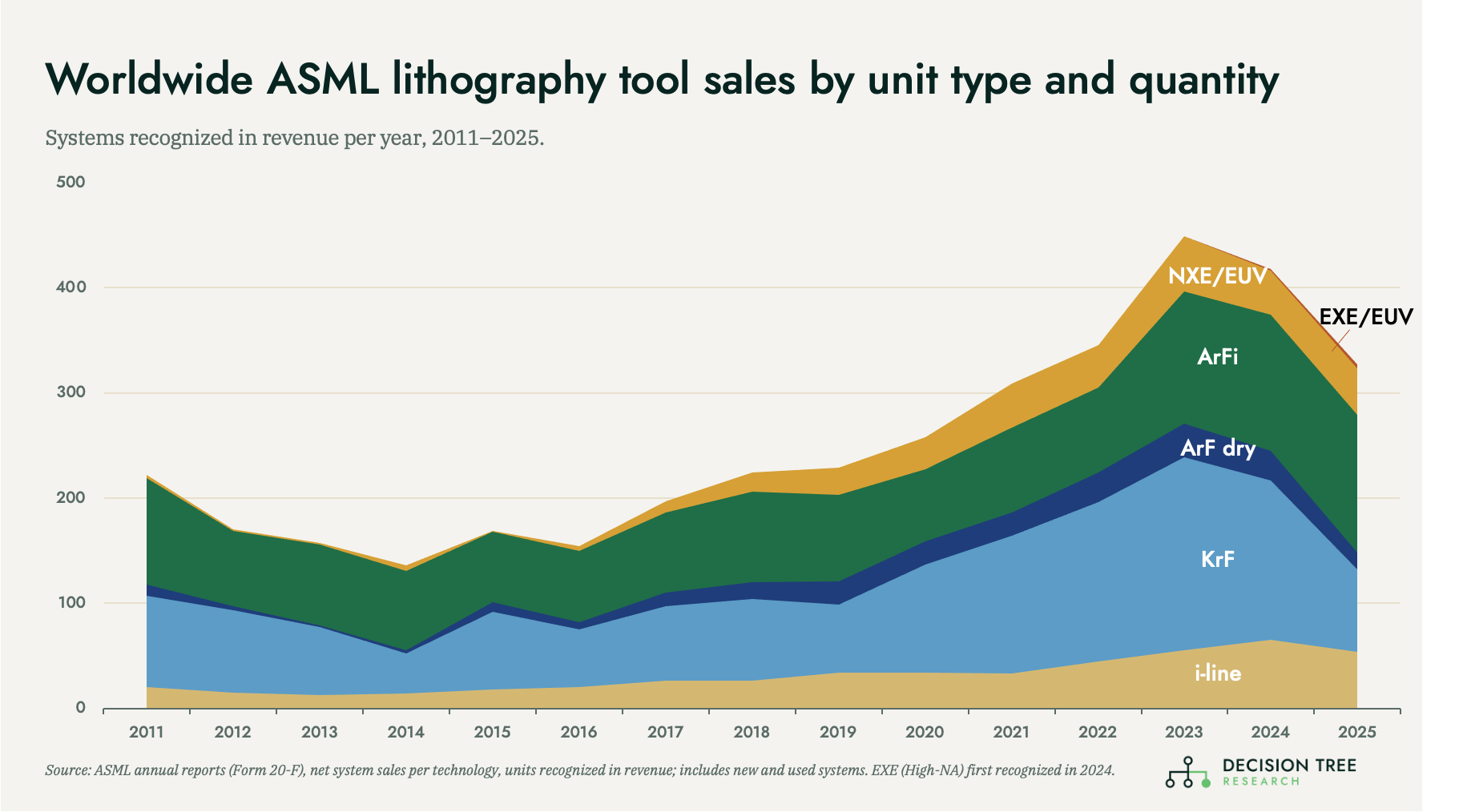
On the quantity side, The Information article reported that Aishengna will make 5 immersion DUV machines in 2026 and expects to make 20 in 2027. These output metrics are consistent with the pace at which ASML scaled its own immersion DUV production during the 2003–2005 validation phase, during which ASML deployed 13 immersion machines for commercial validation. ASML shipped 131 ArFi systems in 2025 alone, and the overall count of ASML’s deployed immersion DUV systems worldwide is likely more than 1,400, based on ASML’s annual reports. From 2023 to 2025, Chinese companies purchased roughly 230 immersion DUV lithography systems from ASML. So while Aishengna’s current capabilities align with ASML’s early production scaling, they are still nowhere near the overall capabilities of the incumbent.
The House China Select Committee published a report that included data on what share of ASML’s immersion lithography machines went to China for the years 2021-2024. These are summarized in the below table:
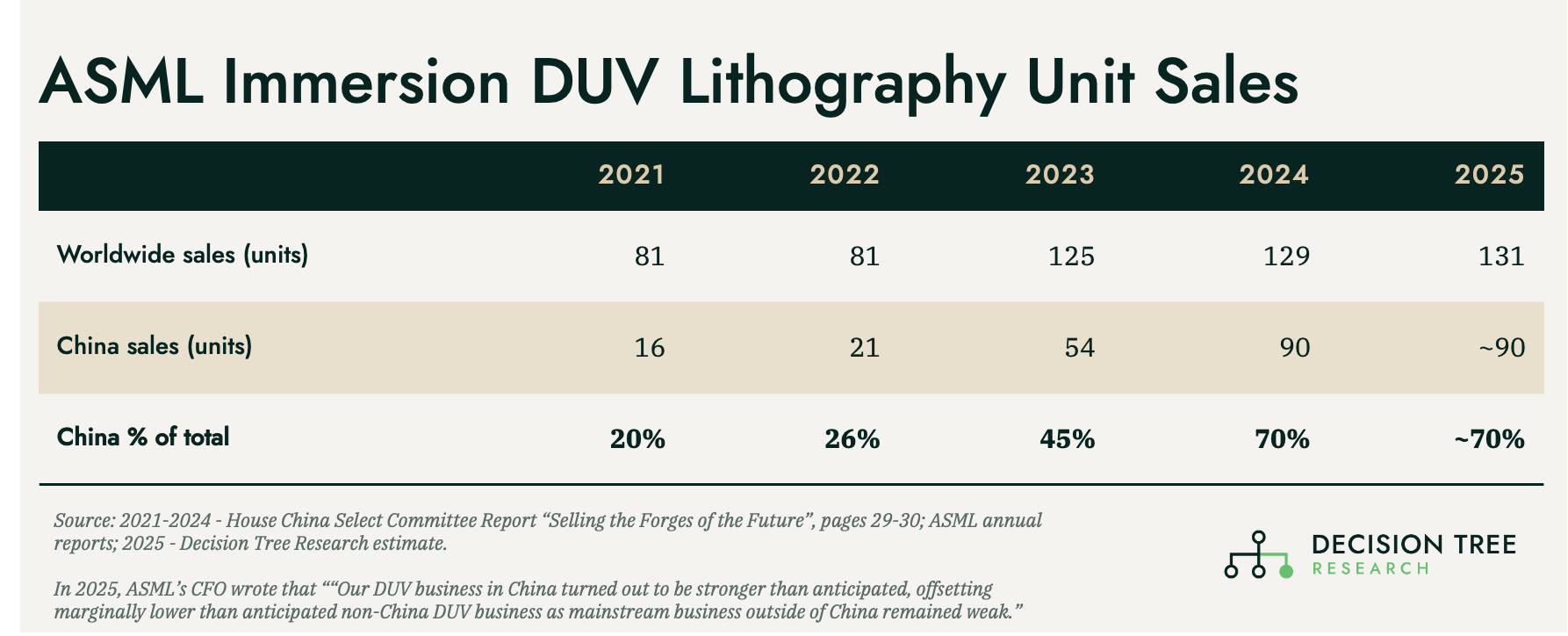
While Aishengna’s expected sales next year of 20 units are small relative to ASML’s 2025 production and tiny relative to ASML’s global install base of machines, they do show a potential path toward meaningfully increased DUV lithography self-sufficiency for China. To begin, a significant share of China’s recent purchases of immersion DUV machines are likely future demand pulled forward in expectation of future export controls. In other words, Chinese firms have been buying as many machines as they can during the window of availability that is feared to be closing. By 2027 China’s annual demand for immersion DUV lithography machines may be considerably below the 90 machines purchased in each of the years 2024 and 2025, perhaps closer to the 21 machines purchased in 2022.
But ASML also shows how fast production can ramp: once production of the ArF immersion machines got underway, ASML was making 93 units annually only five years later.
2005: 13
2006: 23
2007: 38
2008: 56
2009: 31
2010: 93
Moreover, dramatically increasing China’s stock of immersion DUV machines is likely of less strategic importance to China than ensuring that Chinese firms can keep their existing fleet of machines operating and producing chips. This requires replacing parts that wear out or otherwise fail. For example, only two companies are known to produce ArF immersion light sources with sufficient power for the 20nm node or better: Gigaphoton of Japan and Cymer, an ASML subsidiary based in the United States. The consumable modules in these light sources degrade with usage and require replacement every year or so.
Neither The Information nor the Reuters article included information regarding whether or not the Aishengna machines are copies of ASML machines. However, industry participants have said that Chinese semiconductor manufacturing equipment designs are typically near-copies of foreign machines. If true in this case, Aishengna’s ability to successfully manufacture integrated machines could imply that it is also capable of manufacturing a meaningful share of the spare parts required to keep the hundreds of immersion DUV machines already in China running. Two exceptions would apply: (1) instances where Aishengna is still dependent upon foreign subsystem and component suppliers even for its own machine and (2) instances where Aishengna’s equivalent components cannot match the performance or reliability of those used in ASML machines.
6. Are China’s immersion DUV machines competitive with those of ASML?
This brings us to the quality part of the story. A machine that frequently produces defects cannot make very many functional chips, much less be economically competitive.
Performance characteristics like yield, throughput, and downtime determine the true return on investment for lithography machines and their ability to be productive. JP Morgan analysts correctly observed on July 28 that “producing a handful of immersion DUV tools is not the same as producing tools that can be used for high-volume manufacturing, where yield, overlay, throughput and reliability over thousands of wafer runs are what matter.”
Though immersion DUV lithography is a 20-year-old technology, ASML has been refining and improving its designs for that entire period. The reports from The Information and Reuters did not clarify whether Aishengna machines approach the quality of ASML’s best DUV machines, or whether they are more closely comparable to what ASML was producing 15-20 years ago. If the latter is true, it will undoubtedly not take Aishengna 15-20 years to catch up or come close—replicating is almost always easier than innovating. However, China could still be many years away from meaningfully reducing its true dependence on ASML in both new machines and spare parts.
There is little reporting thus far on the performance of the Aishengna machine, but the corporate history of Aishengna is intimately tied up with that of three other Chinese firms: Shanghai Micro Electronics Equipment (SMEE), Shanghai Yuliangsheng, and SiCarrier [a Huawei-linked firm]. According to reporting by Asia Times,
“Yuliangsheng, SMEE and Aishengna are actually sharing the same team of engineers, who are developing a machine similar to SMEE’s SSA800, which has not yet been officially launched.
Yuliangsheng was founded in 2022 and is jointly owned by SiCarrier and the state-backed Chuangkewei (Shanghai) Technology. Last year, SMEE underwent a restructuring that moved its immersion DUV lithography technologies and engineers into Yuliangsheng, while it kept its extreme ultraviolet (EUV) lithography project.
Yuliangsheng’s team is now housed within Aishengna and continues developing the SSA800, though the machine could be renamed to avoid ownership disputes if Yuliangsheng or Aishengna eventually goes public.”
This strongly suggests that the Aishengna machine is actually the direct successor to SMEE/Yuliangsheng’s SSA800, about which there was some noteworthy reporting last year when a Yuliangsheng (which Asia Times claims took over the SMEE immersion DUV project) tool reportedly began trials at the Chinese chipmaker SMIC. The Financial Times described it as a “28 nanometre Chinese-made DUV lithography machine” capable of “utilizing so-called multi-patterning techniques to produce 7nm chips.”
However, Asia Times reported that the SMEE SSA800 immersion DUV machine relied on imports to source components, “including a 193 nm excimer laser mirror, Zeiss lenses, a vacuum chamber, synchronization control algorithm software and argon fluoride (ArF) immersion light sources.” That suggests that local Chinese producers are not yet capable of making many of the key components that would be needed for China to achieve independence in either machines or spare parts.
Moreover, in May 2026, the Chinese semiconductor trade press outlet ICSmart (芯智讯) debunked many of the claims surrounding the yield performance of SMEE’s SSA800 and the status of its acceptance by local Chinese chipmakers. However, the ICSmart report did claim to have confirmed some reported performance details as accurate, stating that the SSA800
“is a 193nm ArF immersion lithography machine, comparable to the ASML TWINSCAN NXT:1950i. The [1950i] has a dedicated chuck overlay accuracy of 2.5nm and a hybrid matching overlay accuracy of 3.5nm, and can process 200 wafers per hour. […] the SSA800 series has an overlay accuracy controlled between 2.3 and 2.5nm and can process 150 wafers per hour.”
7. Can Chinese chipmakers produce advanced AI chips using ASML’s immersion DUV machines?
If “advanced” means comparable in performance to the latest and greatest Nvidia chips, then the answer is clearly no. If “advanced” means “useful to some degree for modern AI applications,” then the answer is yes. Using ASML immersion DUV machines, SMIC has demonstrated the ability to manufacture Huawei AI chips at the SMIC equivalent to the TSMC 7nm (aka N7) node. TSMC first began running the 7nm node in 2018, also using immersion DUV. While Apple began using that node as soon as it became available and moved on to TSMC’s 5nm (aka N5) node in 2020, Nvidia was still using the TSMC 7nm node for its A100 data center chips when they were introduced in 2020. The successor generation of Hopper chips, which used TSMC’s custom 4N node (confusingly, part of TSMC’s 5nm process family), went on sale in late 2022.
In simple terms, each new generation of AI chips brings two sources of performance improvement: a superior manufacturing process node—which allows more transistors to be crammed into a given chip wafer area—and improved chip design, in which designers make better use of that manufacturing process for the applications their chip is intended to serve. When effectively enforced, U.S. export controls cut Chinese chip designers off from most of the post-2020 process node performance improvements. However, they can still improve their designs within that constraint. This means that Chinese 7nm chips can be superior to what Nvidia’s 7nm era chips offered because Chinese chips can incorporate some of the AI-chip optimization design lessons that the industry has learned since 2020.
Increasingly, however, AI performance depends not just on the logic chip, but also on the surrounding high-bandwidth memory and advanced packaging for the full module, both of which are key bottlenecks for China. China also faces major limitations in the number of AI chips that it can produce with its existing inventory of advanced machines and the amount of AI-relevant computation that these chips will deliver.
8. Can Chinese chipmakers produce advanced AI chips using Aishengna’s immersion DUV machines?
The above relates to what China can accomplish with ASML’s immersion DUV machines. The remaining question is how much China can accomplish with the machines provided by Aishengna. As mentioned above, Chinese sources describe the local machine as comparable to the ASML TWINSCAN NXT:1950i, which is an older tool than SMIC currently uses for its 7nm process. Immersion DUV tools can only reach below the 28nm node by using multi-patterning, where the binding constraint is the overlay budget. An overlay of 2.5nm, which the 1950i has, is generally not good enough to enable quadruple patterning for 7nm-class critical layers. 7nm-class critical layers run on ~1.6nm dedicated-chuck-overlay tools (ASML’s NXT:1980Di class, the machines SMIC uses or better). Even the SSA800’s claimed 2.3nm is nearly a nanometer short. This suggests that, without further improvements, the first generation of Aishengna immersion DUV machines will (in the best case for China) match 1950i performance and thus not be useful for making AI chips. More likely, they will be used to make legacy node chips, to improve Aishengna’s rate of learning in partnership with Chinese chipmakers, and to refine future lithography machine designs that will be more relevant to the AI sector.
To make a dent in the U.S.–China AI race, China needs to produce both more lithography machines and better lithography machines. In the absence of direct insider information about the trajectory of the Chinese program, we can look to the precedent of ASML to get a sense of what is possible. Presumably China will reach the milestones ASML hit 18 years ago faster than ASML originally did. After all, China has many significant advantages:
Access to many copies of working ASML machines for reverse engineering
Former ASML technicians and engineers now working for Chinese companies
Access to working foreign components and subsystems to fill local gaps in supply chain availability and performance
Massive government financial support
Help from government cyberespionage and industrial espionage
9. What is the U.S. government’s policy on China buying vs. locally producing immersion DUV lithography machines?
Since the October 7, 2022 export controls, the U.S. government has had a clear policy against U.S. companies and U.S. persons supporting the advancement of the Chinese semiconductor manufacturing equipment sector in any way. This included adding an additional 140 firms to the entity list in December 2024, of which 20 were Chinese semiconductor equipment, materials, and component makers.
At the same time, the U.S. government has allowed the export of DUV immersion lithography machines to China provided that their performance (including chuck overlay) is not above a certain threshold. The idea was that allowing continued sales of such “legacy” machines would reduce China’s interest in producing local equipment alternatives while contributing little to China’s ability to produce AI-relevant chips. The original reasoning behind this is not obviously unsound, but it does appear that the United States has allowed China to massively stockpile these machines (and thus increase China’s global share of chipmaking) without diminishing China’s commitment to locally producing lithography machines. Embarrassingly, the Financial Times reported in December 2025 that Chinese fabs were successfully importing in components that allowed them to upgrade their ASML lithography machines to boost performance past the levels allowed by export contols.
At the same time, the U.S. government has been, by its own admission, unable to fully align the export controls posture of other key countries in the semiconductor value chain. Under Secretary of Commerce Jeffrey Kessler admitted this explicitly in his Congressional testimony last month. The fact that the United States is attempting to block sales of key categories of semiconductor manufacturing equipment while allowing key allies to continue selling key components and subsystems to the Chinese companies working to defeat these export controls is absurd.
The second Trump administration, for its part, suggested in its July 2025 AI Action Plan that it would end this contradiction. Specifically, it stated that
“The United States must also prevent our adversaries from using our innovations to their own ends in ways that undermine our national security. This requires new measures to address gaps in semiconductor manufacturing export controls, coupled with enhanced enforcement. […] America must impose strong export controls on sensitive technologies. We should encourage partners and allies to follow U.S. controls, and not backfill.”
To plug loopholes in existing semiconductor manufacturing export controls, the Plan called for policy actions such as:
Develop new export controls on semiconductor manufacturing sub-systems. Currently, the United States and its allies impose export controls on major systems necessary for semiconductor manufacturing, but do not control many of the component sub-systems.
Coordinate with allies to ensure that they adopt U.S. export controls and work together with the U.S. to develop new controls.
These prescribed policy actions directly address the regulatory disconnect between the U.S. and its allies that has accelerated China’s effort to develop local immersion DUV machines, and the lack of progress on them is what Representative Young Kim pointed out to Under Secretary Kessler in the Committee hearing. The “incomplete cooperation” Kessler describes is disappointing given that this Trump administration has not shied away from making requests of allies for other issues, from increasing defense spending to negotiating new trade deals. It is surprising that the Trump administration has not been more forceful and direct in aligning export controls on such critical inputs for strategically relevant technologies.
10. What Would the MATCH Act Do About This?
The Multilateral Alignment of Technology Controls on Hardware (MATCH) Act is a piece of bipartisan legislation that has been introduced in both the House and the Senate to codify export controls on covered semiconductors and semiconductor manufacturing equipment. One way of understanding the MATCH Act is that it would fill the gap between what the Trump administration said that it wanted to do in the AI Action Plan and what it has actually done as described in Under Secretary Kessler’s recent testimony. It would dramatically expand country-wide prohibitions on semiconductor manufacturing equipment. The bill’s text explicitly includes “all deep ultraviolet immersion photolithography machines” in its definition of “Covered Semiconductor Manufacturing Equipment.” The Act would also designate all subsidiaries, affiliates, and chipmaking facilities run by the most technologically sophisticated Chinese chipmakers (CXMT, Hua Hong, Huawei, SMIC, and YMTC) as being covered by the entity list. It would also give allies 150 days to adopt equivalent controls before the application of the Foreign Direct Product Rule, effectively making foreign exports of covered machines, components, and subsystems to China illegal under U.S. law. Finally, it would treat servicing of installed equipment as a first-class control, meaning that ASML and other equipment vendors could no longer repair or provide upgrades to existing advanced equipment in China.
11. Conclusion: How Big Is China’s Reported DUV Semiconductor Lithography Breakthrough?
Smaller than the one-day drop in ASML’s share price implied, but bigger than China’s official silence suggests.
The milestone itself appears genuine. Twenty-two years after immersion DUV lithography first entered commercial production, a Chinese firm has reportedly begun volume production of a domestic equivalent — and measured against China’s own stated ambitions, it is arriving roughly on schedule. Made in China 2025 called for domestic production of immersion DUV machines before 2025. Aishengna appears to have delivered about a year late.
Measured against self-sufficiency, however — the goal Beijing actually cares about — the breakthrough is modest on every dimension that matters.
On quantity, Aishengna’s expected 20 machines in 2027 compare to the 131 immersion systems ASML shipped in 2025 alone and a global installed base of more than 1,400.
On quality, the machine’s claimed performance is comparable to what ASML was selling 18 years ago, with overlay accuracy that falls short of what 7nm-class AI chip production requires. And the performance data that matters most, defect rates and reliability once the machines are running in actual fab production, does not yet exist in the public record. If the machines prove unreliable, the true story may be less that Chinese chipmakers are eagerly buying Aishengna’s products and more that the Chinese government pressed chipmakers to accept them, possibly at no cost, to help Aishengna mature.
And on independence, the machine still depends on critical imported components that China cannot yet make. China has not built an ASML rival. It has cut ASML out of final assembly while remaining reliant on the foreign suppliers beneath it. That is a huge gap in the existing U.S. and allied export controls architecture, which has always underestimated the importance of key components.
But judging this development by its current level would repeat the error that export control skeptics make about Chinese chipmaking: the right measure is trajectory, not position. A firm that can integrate a working immersion scanner can likely also manufacture a growing share of the spare parts that keep China’s existing fleet of hundreds of ASML machines running — arguably the more strategically important capability. And with working machines to study, poached engineers, imported components, and massive state financial support, China should be expected to climb ASML’s learning curve considerably faster than ASML did. The binding constraint on that climb is now components rather than finished machines — which is precisely where U.S. and allied export controls remain weakest, and precisely the gap the AI Action Plan promised and the MATCH Act would actually close.
For the past several years, China has been buying everything it can from the store before it closes. The Aishengna reports show something new: China is learning to run a store of its own. For now, its shelves hold last decade’s models, stocked partly with imported parts. The task for U.S. policy is to keep it that way for as long as possible.